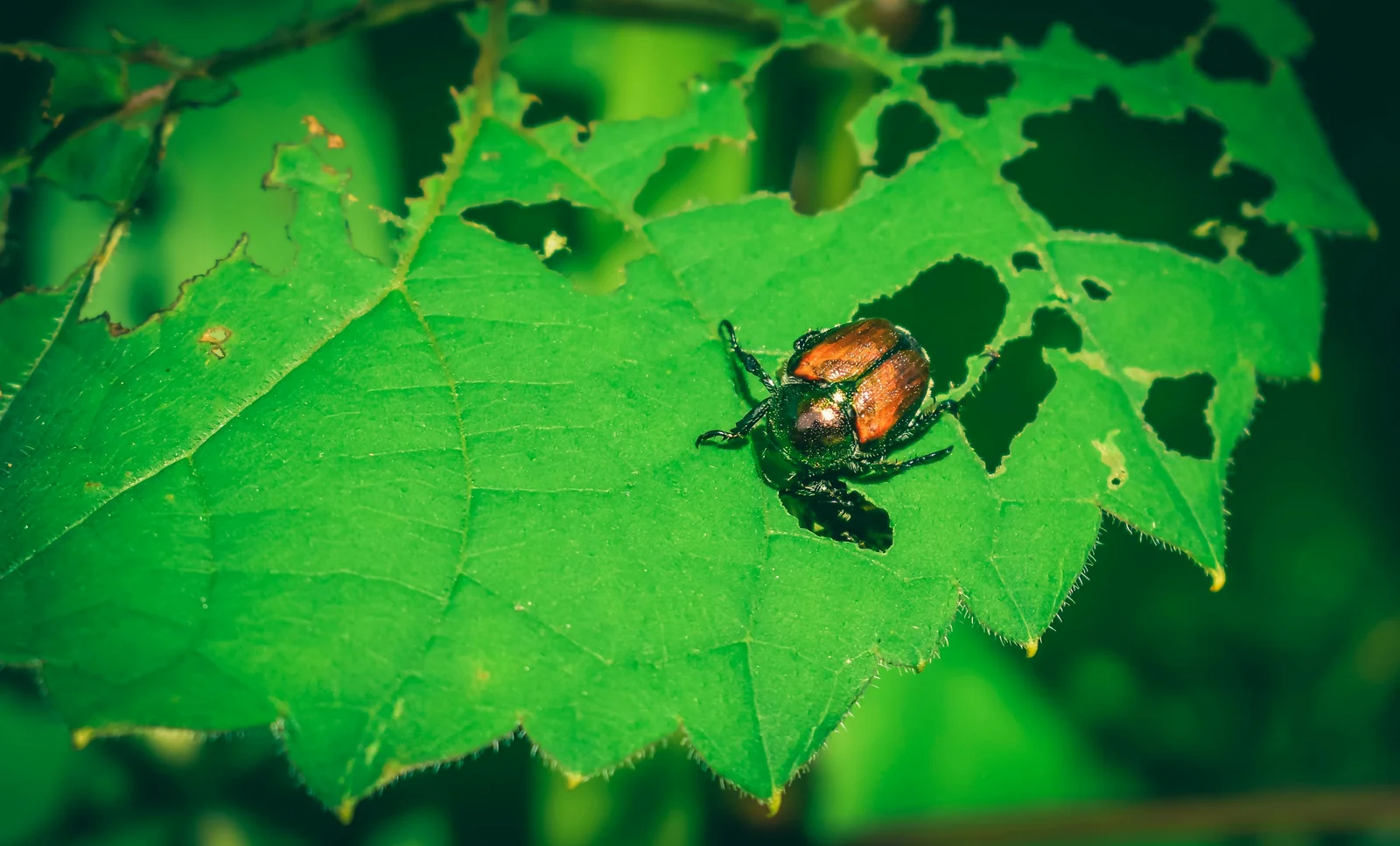
June 1, 2026 · Pest Control · By Mike Harmon, Owner & Licensed Applicator
Right now your landscape probably looks great. Give it three weeks. By the last week of June, metallic green and copper beetles start showing up on roses, lindens, crabapples, and grapevines across Noblesville, Carmel, and Fishers, and they don't show up quietly. Japanese beetles feed in groups, they feed out in the open, and they can turn a healthy shrub into brown lace in a matter of days.
Here's the part most homeowners don't connect: the beetle chewing on your roses in July is the same insect that will be eating your lawn's roots from below by late summer. Same pest, two life stages, two completely different kinds of damage. If you understand the cycle, you can get ahead of both. If you wait until you see them, you're already behind.
This post covers what they look like, why they keep coming back, what actually works for treatment, and the popular advice that doesn't. We treat them every summer for customers across Noblesville, Carmel, Westfield, Fishers, and the rest of Hamilton County, so this is the playbook we use ourselves.
How to Identify a Japanese Beetle
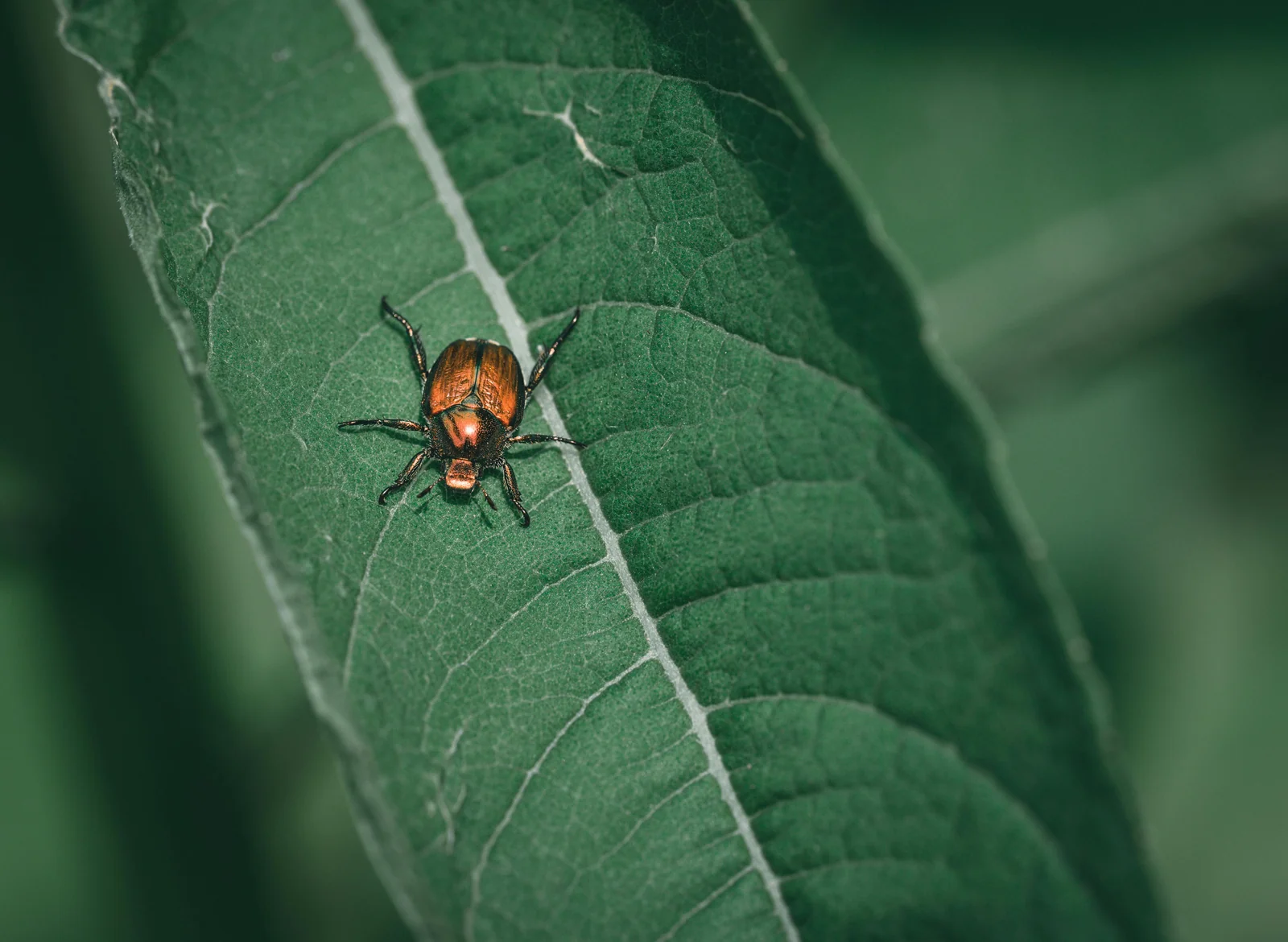
Adult Japanese beetles (Popillia japonica) are about 3/8 inch long with a metallic green head and thorax, copper or bronze wing covers, and small white tufts of hair along the sides of the abdomen. They are stunning to look at and deeply destructive in equal measure.
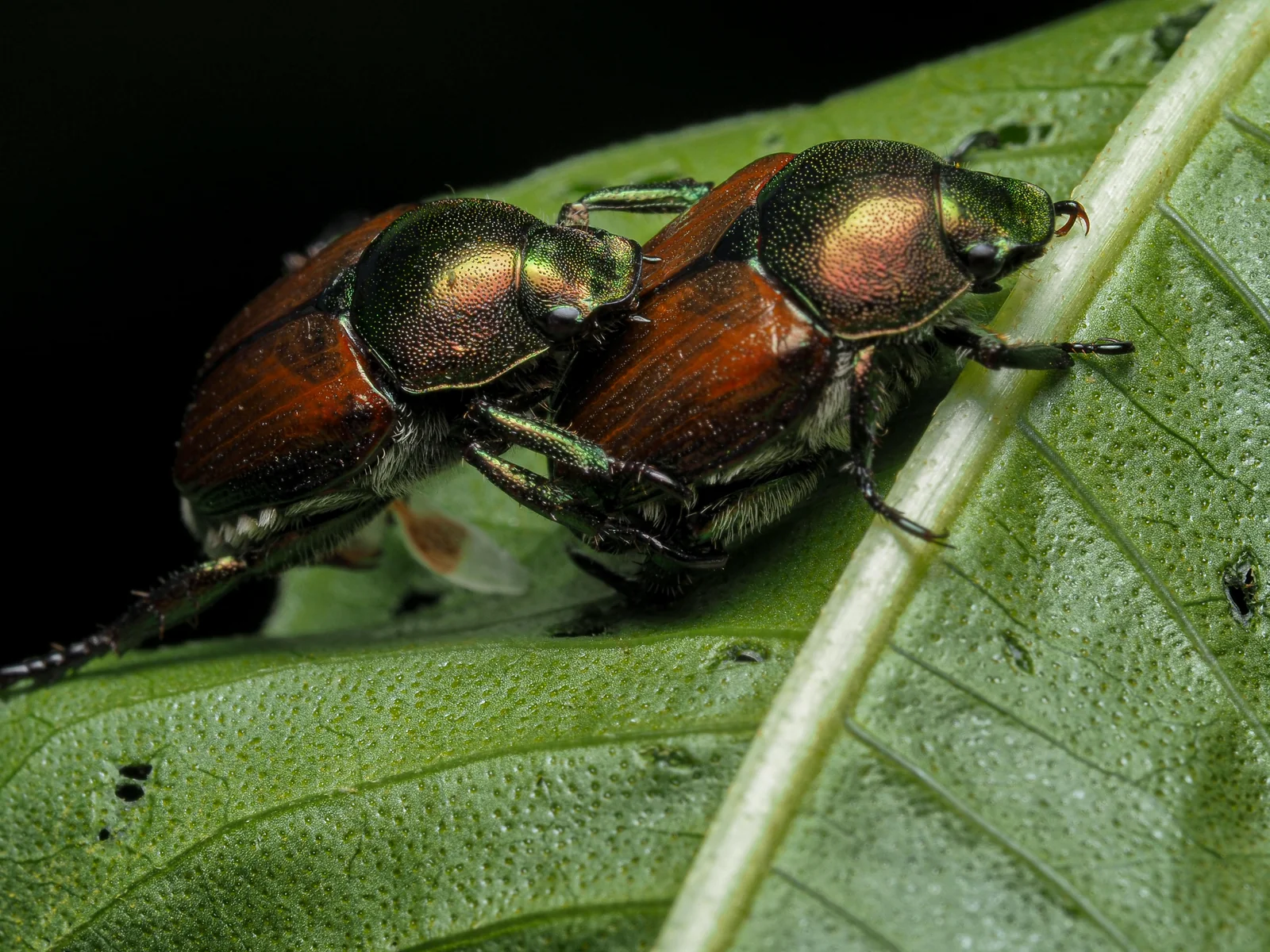
You will rarely see just one. Japanese beetles are gregarious feeders. Once a few find a host plant, they release pheromones that attract dozens more, and the cluster grows fast. By peak season in July, you can find piles of them mating on the same leaf they are eating.
The Hamilton County Timeline
Indiana's Japanese beetle season is fairly predictable:
- Mid-June: First adults emerge from the soil, where they spent the past 10 months as grubs feeding on grass roots.
- Late June through mid-July: Peak adult population. This is when damage is heaviest and when most customers call us.
- Late July through August: Adults continue feeding while females burrow into lawns 2 to 4 inches deep to lay eggs. A single female can lay 40 to 60 eggs in her lifetime.
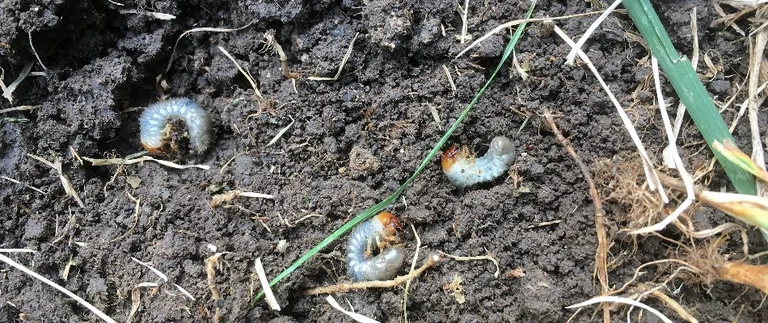
- August into fall: Eggs hatch into small grubs that begin feeding on grass roots near the surface. Damage typically starts showing up around August as the grubs grow, and continues as long as they keep feeding.
- November through April: Grubs move deeper into the soil to overwinter, then come back up in spring to feed before pupating.
- June (the next year): The cycle starts again.
The lifecycle matters because the timing of your treatment matters. Adults get treated in summer. Grubs get treated in late June through July (preventative) or in late summer once they are active (curative). More on that below.
What the Damage Looks Like
Two distinct types of damage, depending on whether you're looking at adults or grubs.
Adult damage is the iconic one. Adults eat the soft tissue between the leaf veins, leaving the veins intact. The result is a lacy, skeletonized look that's instantly recognizable once you've seen it. They prefer plants in full sun and tend to start at the top of the plant and work down. Severely fed-on leaves eventually brown and drop. On a rose bush, beetles will also eat the flower petals, leaving ragged-edged blooms.
Their favorite Hamilton County targets, in roughly the order we see damage:
- Roses (their absolute favorite)
- Linden trees (entire tree canopies can turn brown)
- Japanese maples
- Crabapples
- Cherry and plum trees
- Grapes and raspberries
- Hibiscus and hollyhocks
- Hostas (later in the season once other hosts are stripped)
They will feed on more than 300 plant species, but if you have any of the above, that's where they will be first.
Grub damage looks completely different. It typically starts showing up around August, once the newly hatched grubs are feeding on roots, as irregular brown patches of turf that pull up easily because the roots have been chewed away. Skunks and raccoons digging up your lawn at night looking for grubs is another giveaway. How to tell if your lawn has grubs covers the diagnostic steps in detail.
Why Your Yard? (Aggregation Behavior)
Japanese beetles don't pick yards at random. They pick based on three things: a host plant they like, a pheromone signal from beetles already feeding there, and the presence of healthy turf nearby for egg-laying.
That third one matters more than people realize. A well-irrigated, healthy lawn is the perfect nursery for next year's beetle population. Female beetles prefer to lay eggs in moist soil with thick turf, which means our customers with the nicest lawns often get the heaviest beetle pressure. This isn't a reason to let your lawn die. It's a reason to add preventative grub control to a healthy lawn care program.
Treatment That Actually Works
There are three legitimate ways to control Japanese beetles, and they target different parts of the life cycle.
1. Foliar Treatment for Adults (Summer)
The most effective adult treatment is a direct foliar spray of a professional-grade pyrethroid product (active ingredients like bifenthrin, lambda-cyhalothrin, or deltamethrin) applied to the plants beetles are feeding on. The product kills on contact and provides residual control for one to three weeks, depending on weather and product.
This is different from the fogging treatment used for mosquitoes. Mosquitoes fly through the air column and the fog catches them mid-flight. Japanese beetles cluster on specific plants, so they get sprayed directly. Same family of active ingredients in many cases, very different application.
If you treat for beetles yourself, the most important rules are:
- Spray in the early morning or evening when beetles are less mobile and bees are less active
- Coat both the tops and undersides of leaves where beetles cluster
- Avoid spraying when plants are in active flower if you can, to protect pollinators
- Reapply on a 2 to 3 week cycle through the active season
2. Preventative Grub Control (Late June through July)
This is the single best long-term move. Applying a preventative grub product (chlorantraniliprole is the modern best-in-class option, with imidacloprid still common) to your lawn in late June or July kills this year's freshly hatched grubs before they cause root damage. It also significantly reduces next year's adult beetle population on your property, because most of those adults would have come from grubs you just killed.
Preventative is dramatically cheaper and more effective than curative treatment after grub damage has shown up. If you only do one thing for Japanese beetle control, do this one.
3. Cultural and Mechanical Control
For small infestations, hand-picking works. Knock beetles into a bucket of soapy water in the early morning when they are sluggish. Do this daily for two weeks during peak emergence and you can make a real dent on a single rose bush or small ornamental.
Beyond that, the main cultural tool is plant choice. If you keep losing the same rose bushes every year, consider replacing them with plants beetles don't prefer (boxwood, redbud, red maple, dogwood, magnolia, lilac, forsythia, holly). Some properties just shouldn't have linden trees.
What Doesn't Work (Or Makes It Worse)
Japanese Beetle Traps
If you remember nothing else from this post, remember this: do not buy a Japanese beetle trap.
The traps work by releasing two attractants: a sex pheromone (males to females) and a floral lure (everyone to the bag). Purdue Entomology (E-75, Japanese Beetles in the Urban Landscape) is direct about it: the traps attract more beetles than they catch, and the beetles that don't make it into the bag end up feeding on the plants around the trap. The result is more beetles on your property, more feeding damage on your plants, and more eggs in your lawn for next year.
The trap manufacturers know this. The fine print on most trap packaging recommends placing the trap "at least 30 feet from desirable plants." That's the company telling you the trap attracts beetles and you should keep it away from anything you care about.
If you have a trap and want to keep using it, put it as far from your prized plants as physically possible. Ideally at the back of the neighbor's yard, with their permission. Better yet, take it down.
Soap and Water on the Lawn
Old internet advice says to spray dish soap on your lawn to drive grubs to the surface. It can drive grubs up briefly, but it doesn't kill them, and the soap damages the lawn. Not a real treatment.
Geraniums (the Suicide Pill Myth)
Geraniums contain compounds that temporarily paralyze Japanese beetles after they feed on the flowers. The internet has turned this into "plant geraniums and the beetles die." In reality, the paralyzed beetles wake up and fly away after a few hours. The geraniums get destroyed in the process. Not a control strategy.
Milky Spore
Milky spore (Paenibacillus popilliae) is a soil-applied bacterial product marketed as a long-term biological control. The research on it in cool northern climates like Indiana is mixed at best. Establishment takes years, results are inconsistent, and the cost is high relative to a single year of effective preventative grub control. It can be worth experimenting with as a long-term layer on top of conventional treatment, but it should not be your primary plan.
How Sprout Handles Japanese Beetles in Hamilton County
Our approach is two-pronged because the problem is two-pronged.
For adults during peak season, we treat ornamental plants and trees with professional pyrethroid foliar applications. Roses, lindens, Japanese maples, and any other heavily-targeted ornamentals get sprayed on a schedule through July and into early August. The products we use come from SiteOne, the same supplier that stocks most commercial lawn and pest care companies in central Indiana.
For grubs (which is really beetle prevention), we apply preventative grub control to lawns in late June or July. This is the single highest-leverage treatment in the whole cycle. It kills next year's beetles before they ever become a problem.
Many of our customers bundle Japanese beetle ornamental treatments with their existing mosquito control program, since our crews are already on the property and have the equipment.
Get ahead of the beetles and the grubs.
Preventative grub control goes down in June and July, before the damage ever starts. It is the single highest-value treatment in the whole cycle and it stops next year's beetles too.
Adult beetle protection for your roses, lindens, and other ornamentals can be added any time during the season.
Call Now: (317) 900-7151Prefer to write? Email faith@sproutlawns.com or use our contact page.
FAQ
When do Japanese beetles emerge in Indiana?
Adults emerge in Hamilton County roughly mid-June through late June, peak through July, and start declining in August. Active season is about 6 to 8 weeks.
Do Japanese beetle traps work?
No. They attract more beetles than they catch and make the problem worse. If you must trap, place the trap far from any plants you care about.
What plants do Japanese beetles attack most?
Roses, linden trees, Japanese maples, crabapples, hostas, hibiscus, grapes, and raspberries are top targets. They will feed on more than 300 species but prefer the soft tissue between leaf veins.
How do I treat Japanese beetles on my plants?
Professional pyrethroid-based foliar treatments applied directly to affected plants give the best control. Hand-picking into soapy water works for small infestations. Skip pheromone traps.
Is grub control the same as Japanese beetle control?
They are connected. Grubs are the larval stage. Preventative grub control applied in June or July kills the larvae before damage occurs and reduces next year's adult beetle population on your property.
The Short Version
Japanese beetles will be in Hamilton County yards within 2 to 3 weeks. Treat adults with professional foliar applications on the plants they're feeding on. Apply preventative grub control in June or July to kill next year's beetles before they emerge. Don't buy a trap, don't waste money on geraniums, and don't expect milky spore to fix the problem alone.
If you'd rather hand this off to a crew that handles it every summer, call us at (317) 900-7151 or get an instant estimate online. We service Noblesville, Carmel, Westfield, Fishers, McCordsville, Cicero, Geist, and the rest of Hamilton County.