October 28, 2023 · Leaf Removal
Hamilton County has no shortage of mature trees, and every fall they dump their leaves on your lawn, your beds, your sidewalks, and your gutters. The question isn't whether you need to deal with the leaves. It's how often you should be doing it.
The One-and-Done Approach
Waiting until every leaf has fallen and doing one big cleanup is the most common approach homeowners take. It's also the riskiest for your lawn.
The problem is timing. In Hamilton County, leaf drop starts in mid-October and can stretch through early December depending on the tree species. If you wait until every leaf is down, the earliest-dropped leaves have been sitting on your lawn for 6-8 weeks. That's long enough to smother grass, create fungal conditions, and provide winter shelter for pests.
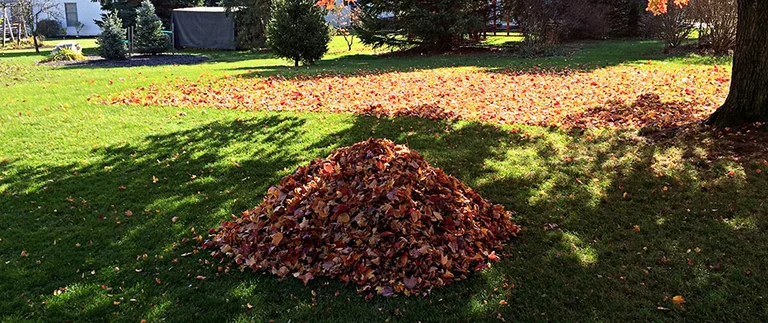
That said, one end-of-season cleanup works OK for properties with light to moderate leaf cover, where there's only one or two trees dropping leaves. The grass underneath might be a little stressed but it recovers in spring.
The Multi-Visit Approach
For properties with heavy tree cover (multiple mature oaks, maples, or sycamores), 2-3 cleanups spaced through the fall is the better strategy. A typical schedule looks like this:
Visit 1 (late October): Clear the early drop. Maples and some oaks drop early. Getting this first wave off prevents the layer-cake effect where wet leaves compress into a dense mat.
Visit 2 (mid-November): Clear the main drop. This is the heaviest volume for most Hamilton County properties. The majority of deciduous trees have shed by mid-November.
Visit 3 (early December, if needed): Catch the stragglers. Some oaks hold their leaves well into December. A final cleanup ensures nothing is left on the lawn going into winter.
What Happens If You Wait Too Long
Snow mold. Wet leaves under snow create the perfect incubator for gray and pink snow mold. You'll see the damage as circular matted patches on your lawn as soon as the snow melts in spring.
Pest habitat. Mice, voles, and ticks use leaf litter as winter shelter. A thick leaf layer at the edges of your property is especially attractive to tick populations. Reducing leaf litter reduces the pest problem.
Suffocated turf. Grass needs sunlight even during winter semi-dormancy. A thick leaf blanket blocks that light and traps moisture, weakening the grass so it comes back thin and slow in spring.
More expensive spring cleanup. Leaves that sat on the lawn all winter are wet, matted, and partially decomposed. They're significantly harder (and more expensive) to clean up in March than they would have been in November.
Our Recommendation
If you have more than a couple trees on your property, schedule at least two leaf removal visits. If you have heavy cover, go with three. Properties in the established Noblesville neighborhoods near Forest Park and along Pleasant Street tend to need the full three-visit schedule because of the dense hardwood canopy. Same goes for the mature neighborhoods in Carmel around Brookshire and Home Place, and the lakefront lots in CiceroGeist where the tree cover is relentless.
Newer developments in Westfield and McCordsville with younger trees can usually get by with one or two visits. But that changes as those trees mature, and it changes faster than most homeowners expect.
The cost of multiple visits through the fall is significantly less than the cost of reseeding bare patches, treating snow mold, and nursing a struggling lawn back to health all spring. Prevention is cheaper than repair every time.
Sprout Lawn & Landscape offers single and recurring leaf removal plus full fall cleanup services across Noblesville, Carmel, Westfield, Fishers, and surrounding Hamilton County. Call (317) 900-7151 to get on the schedule before the leaves start falling.